

What Axios AI+NY Summit told us about the next year of communications
By Jaime Tero, Managing Director, AI Center of Excellence
Allison Worldwide was proud to sponsor the Axios AI+NY Summit, and I came away with a stack of notes and one clear takeaway. The AI story has moved on. We have stopped arguing about whether this technology is real and started discussing who pays for it, who does and does not use it, and who trusts it. Those are big questions to chew on for any communications leader.
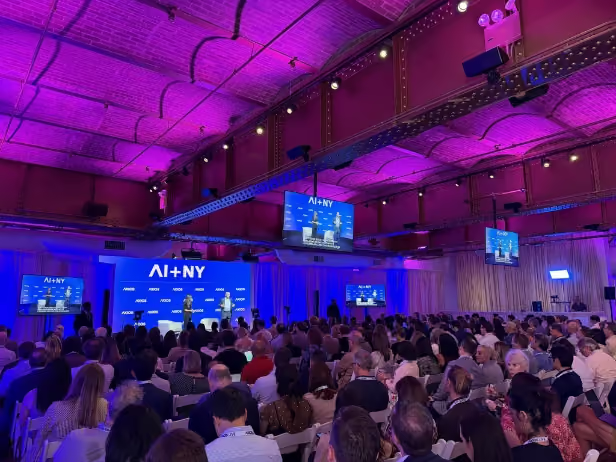
Here is what stood out to me, and why it matters to anyone responsible for a brand's reputation right now.
The cost of AI is now a workforce story
Glean CEO, Arvind Jain gave the number that made the room sit up. A year ago, companies debated paying thirty dollars a seat. Now many are paying roughly a hundred times that, and "AI costs are rivaling payroll.” He said businesses are already adjusting headcount plans to fund it.
The minute "we are spending on AI" and "we are rethinking headcount" appear in the same sentence; you have an internal communications challenge and an external trust problem. This is exactly the kind of moment where the story you tell employees and the story you tell the market must be one coherent story.
Regulation is "voluntary" and that word is now being asked to do a lot of work
Arvind Krishna of IBM was candid about the Trump Administration’s recent AI executive order. He called the regulatory balance the “Goldilocks spot,” light guardrails without the heavy bureaucracy. Then he said the quiet part out loud. The order is technically voluntary, but “it is hard to say no to the guy behind the Oval Office desk,” because federal acquisition rules have real teeth.
"Voluntary" is no longer a clean message. Clients in regulated and government-adjacent spaces now have to talk about compliance they are not legally required to do, in a way that reads as leadership rather than capitulation. The brands that get this right will frame their posture as a choice, not a reaction.
AI adoption is not a launch and Microsoft learned it the hard way
The most useful teaching of the day came from Microsoft's Katie George. Her team rolled out an internal AI tool the way they roll out any product. Strong launch, strong usage and then “it fell off the cliff.” The lesson they took away is that AI adoption is business transformation, not a product launch. It only sticks when you make the actual work visible and connect the tool into how people operate.
This is a communication and change management problem dressed up as a technology problem. The companies seeing real lift are the ones where leaders model the behavior, teams change together and the rollout is run as a culture effort.
AI is not competing with your best work. It is competing with your mediocre work.
Casey Neistat, a YouTube personality, filmmaker, vlogger and co-founder of the multimedia company Beme, had the line that should change how we brief content teams. The argument that audiences will always pay a premium for human-made work is, in his view, wrong. AI is not competing with Spielberg. It is “competing with the perfectly mediocre” content that “fills the messy middle.” He pointed at his own child finding hand-drawn animation unwatchable as proof that today's AI content is simply the next generation's normal.
For brands, that reframes the entire earned and owned content conversation. The defensible ground is not volume, because AI wins volume. The defensible ground is the genuinely human, specific, well-made thing that an algorithm can’t fake. If your content strategy lives in the messy middle, AI is coming for it. If it’s a real point of view and real craft, it gets more valuable, not less.
Trust is the product now
Sarah Kate Ellis of GLAAD said the sentence I keep coming back to. “Trust is the biggest currency with AI and whoever wins the trust war wins the AI war.” GLAAD’s new "Making AI Safe for Everyone" report shows the foundational models carry the bias of the data they were trained on and those models are already advising people on healthcare, loans and jobs. She also flagged a privacy reality most brands have not thought through. These systems can infer who you are from what you ask, and that information is not well protected.
An audience that does not trust you will not use you, and the cost of losing that trust is now existential rather than reputational. The brands that treat trust as a feature, communicate their guardrails plainly and give people real control will pull ahead of the ones that treat it as a compliance footnote.
Putting a wrapper on the event
Across all conversations, the same pattern revealed itself. The technology questions are getting answered, but the complex part remains, which is the human part. How you talk about cost without spooking your people. How you roll out a tool without it dying on the vine. How you earn trust in a system people are right to be wary of. How you stay worth watching when the algorithm and the AI can flood the zone with good enough.
If you want to talk through what any of this means for your brand, our AI Center of Excellence is built for exactly these conversations. Get in touch!

We proudly sponsored Axios AI+NY Summit’s Expert Voices Roundtable, “One Story, Two Audiences,” which explored what it takes to ensure brands are discovered, trusted and recommended in the AI era. Read more in Axios’ article here, “Brands get the message — AI is rewriting all the rules.”